Research
Who is the producer of a licensed brand under SB 707
A reading of California’s textile producer definition for licensed brands, grounded in the September 29, 2026 workshop record.
1. Licensed brands meet a definition built around manufacturing
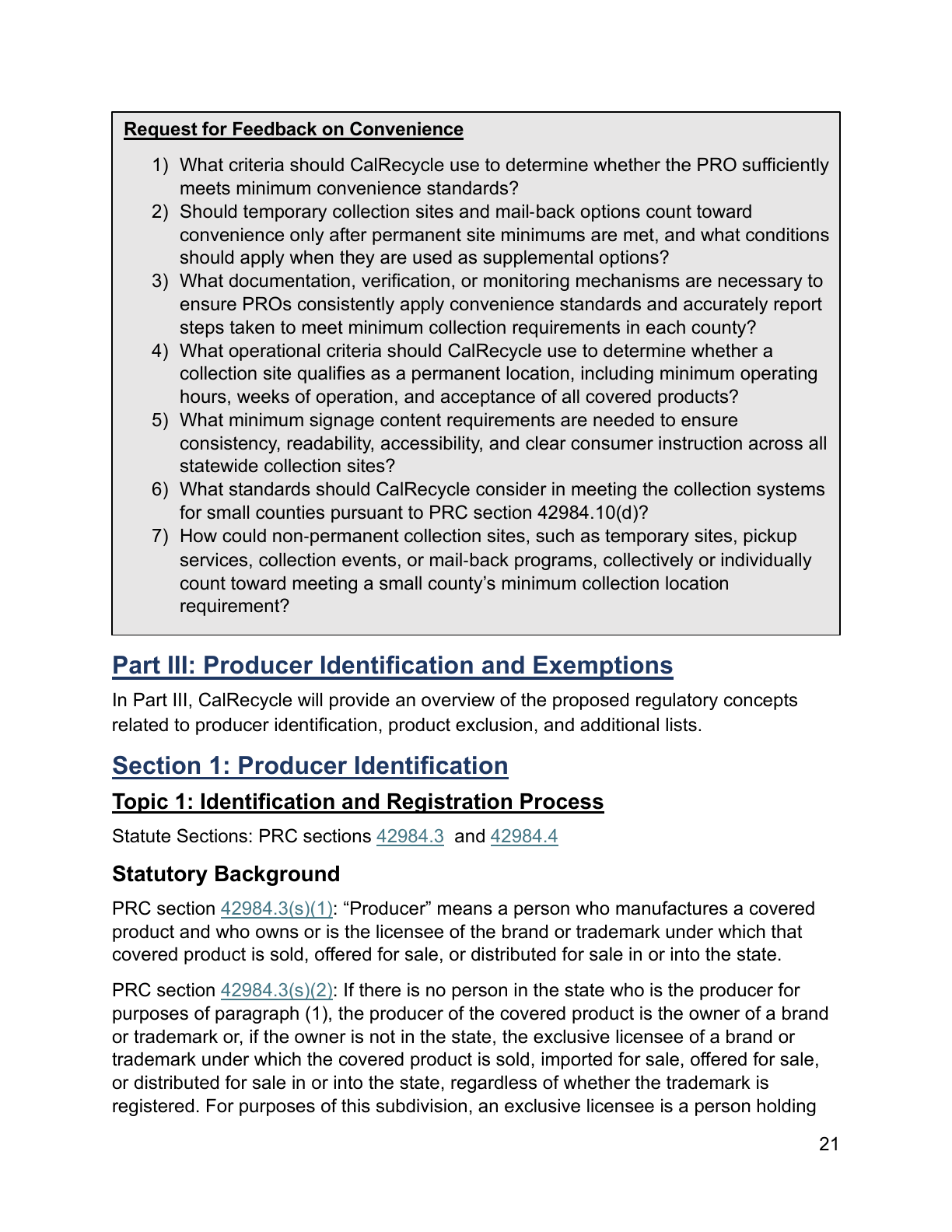
We read SB 707 as reaching licensed brands through a producer definition built around the company that makes a product and owns or licenses its mark. The September 29 concepts add registration, duty-assumption, exemption and list procedures without specifying how those procedures distinguish a licensor from its licensees. In the recorded portions of the workshop, no commenter raised that distinction. Our inference is that the practical question is how the statutory hierarchy becomes a record for each licensed product, rather than whether the word licensee appears in the law.1
Source note 1
Licensed brands account for a large share of the apparel, footwear and accessories market in our assessment, as stated in our October 6 letter. We do not use that assessment as a measured California market share. The statute defines covered products as apparel or textile articles and names footwear, handbags and backpacks among the apparel categories. Its two locations for licensee language are the definition of brand in PRC 42984.3(e) and the definition of producer in PRC 42984.3(s). The wider collection, reuse and end-market concepts are in Parts I and II of the discussion document.2
Source note 2
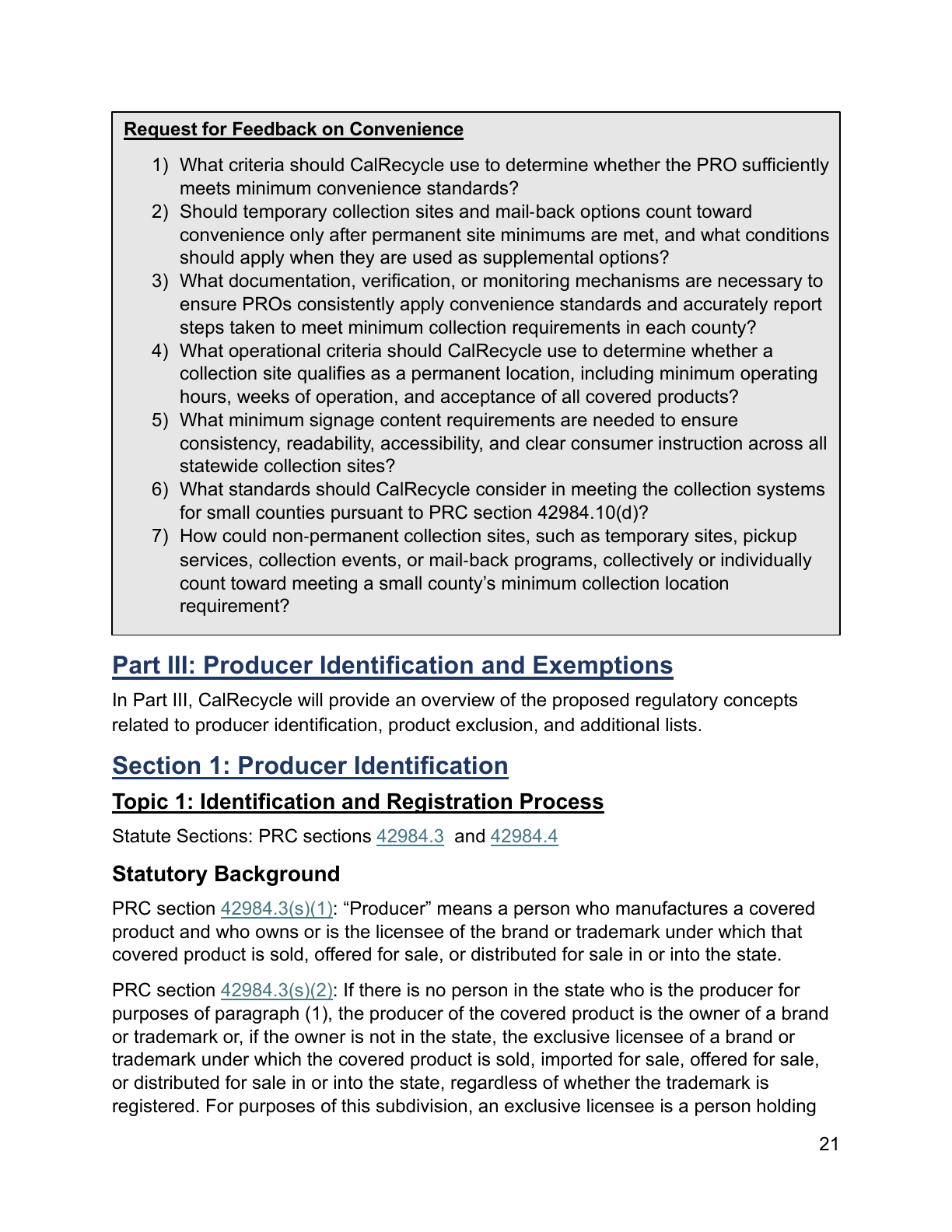
“Producer” means a person who manufactures a covered product and who owns or is the licensee of the brand or trademark under which that covered product is sold, offered for sale, or distributed for sale in or into the state.
The first tier joins two requirements in one person: manufacturing the covered product and owning or licensing the mark. Exclusivity is not stated in that paragraph. If no person in the state qualifies under it, paragraph (s)(2) reaches the brand owner or, if the owner is not in the state, the exclusive licensee. That paragraph defines exclusivity by the right to use the mark in the state in connection with manufacture, sale or distribution of the covered product. We read the difference between these paragraphs as consequential for a non-exclusive manufacturing licensee.3
Source note 3
If neither of those tiers supplies a producer in the state, paragraph (s)(3) reaches the importer. If none of the first three does, paragraph (s)(4) reaches the distributor, retailer or wholesaler selling the product in or into the state. Paragraph (s)(5) deems a sale to occur in California when the covered product is delivered to a consumer there. We read that delivery rule as a rule about the sale’s location, rather than a complete answer to which company occupies a tier.4
Source note 4
Paragraph (s)(6) allows a person who manufactures, distributes, imports, offers for sale or sells the product to assume some or all producer duties and liabilities and relieve another such person. The text does not give every trademark owner an unconditional right to assume duties merely because it owns the mark. Paragraph (s)(8) excludes a seller below $1 million in annual aggregate global turnover, subject to annual inflation adjustment and the listed aggregation rules. We therefore read producer identity, eligibility to assume duties and eligibility for the exclusion as separate questions.5
Source note 5
2. The same mark can lead to different producers
The table applies the hierarchy to five licensing structures. Each result is our reading, conditional on the stated facts and on which persons are in the state. We would begin with a covered product and its chain of manufacture and sale, then test the tiers in order. A brand-wide answer without product and territory boundaries risks skipping the conditions that move responsibility from one tier to the next. A registration record should preserve those conditions so that a later change in manufacturing, import arrangements or exclusivity can be assessed against the original conclusion.6
Source note 6
| Licensing structure | Producer under the statute as written | What registration would ask | What remains to be resolved |
|---|---|---|---|
| US manufacturer-licensee, non-exclusive license | Our reading: the licensee under (s)(1), if it manufactures and qualifies in the state. That paragraph does not state exclusivity. | Manufacturing and brand-license evidence. PRC 42984.3(s)(1), discussion document p. 22. | US location alone does not settle the in-state condition. PRC 42984.3(s)(2), discussion document p. 23. |
| Foreign licensor, one exclusive California licensee | Our reading: the licensee under (s)(2), if no in-state (s)(1) producer exists and the licensor is not in the state. | Evidence of the exclusive California right for the covered product. PRC 42984.3(s)(2), discussion document p. 22. | The licensor’s location and any qualifying manufacturer must be tested first. PRC 42984.3(s)(1)–(2). |
| Several category licensees, some importing and some manufacturing | Our reading: apply the hierarchy per covered product. A qualifying manufacturing licensee may occupy (s)(1). An importer is reached only after (s)(1)–(2). | Product-category, licensing and importer records. PRC 42984.3(s)(1)–(3), discussion document p. 22. | Category exclusivity and overlapping brand records need a defined scope. PRC 42984.3(s)(2), discussion document pp. 22, 29. |
| Licensor approves product specifications | Our reading: approval alone does not expressly determine manufacturing status in (s)(1). The statutory sequence still applies. | Agreement provisions describing approval and manufacturing roles. PRC 42984.3(s)(1), discussion document p. 22. | Whether this control constitutes manufacturing is not specified in (s)(1). Oregon and Colorado packaging precedents are comparisons only. Sources 10–11. |
| Out-of-state licensee sells direct to California consumers | Our reading: delivery locates the sale in California under (s)(5). Producer identity still requires the hierarchy in (s)(1)–(4). | Manufacturing, licensing, delivery and jurisdiction facts. PRC 42984.3(s)(1)–(5), discussion document pp. 22–23. | The proposed territorial criteria do not fully specify their interaction with each tier. Discussion document p. 23. |
Every application is our inference. “In the state” is a condition to establish, not a synonym for having a US address.
The specification-approval row deserves a separate inquiry. Oregon’s packaging rule includes directing manufacture within manufacturing, including setting packaging specifications. Circular Action Alliance’s Oregon guidance distinguishes a licensor that merely licenses a mark from one that directs production. Its Colorado guidance describes a tier for a brand owner directing or performing manufacture of packaging, followed by the licensee directing manufacture. These are packaging precedents, not SB 707 rules. Our inference is that approval rights merit examination, without importing either state’s result into California textile law.7
We would also separate a conclusion about one agreement from a conclusion about the whole brand. A category licensee may have manufacturing rights for one covered product and import another. An exclusive right may have geographic and product limits. Under our reading, a useful record names the entity, covered products, territory, relevant agreement provisions and proposed tier together. It also records the facts that would change the result. That is a practical way to test the registration concept, rather than a new legal requirement we attribute to it.6
Source note 6
3. The concepts require records without resolving the licensing relationship
Part III’s written concepts address producer identification, product exclusions and additional lists. We rely on the discussion document for Section 1’s registration, territorial, duty-assumption and small-seller language. The transcript captured the introduction of those topics and the move to Section 2, but not an oral presentation of the Section 1 concepts. The distinction matters: the passages below are what the agency wrote, not words reconstructed from the webcast.8
Source note 8
3.1 Registration would record the evidence for a place in the hierarchy
Collection and storage of records on brand ownership and licensing, importer-of record, and distributor and retailer details.
The registration concept would make the producer responsibility organization, or PRO, responsible for mapping an entity into the producer hierarchy. It would provide registration forms, documentation and a registration number, maintain an inventory and submit it to CalRecycle. Updates would include annual updates and changes within 30 days of a change in producer status. Feedback question 2 asks what documentation identifies a brand owner, licensee, manufacturer, distributor, importer or wholesaler. That is the express licensee reference in the September registration feedback questions.9
Source note 9
Our reading is that the agreement’s allocation of manufacturing rights, exclusivity and territory should be available beside the claimed tier. A declaration that the company handles the brand is too imprecise to distinguish ownership from a license or a non-exclusive grant from an exclusive one. We would ask for the governing provisions or an attestation identifying them. The concept asks for documentation but does not yet specify this form of evidence. Our recommendation responds to that request rather than treating an agreement-upload requirement as adopted.9
Source note 9
3.2 Delivery into California does not answer every territorial question
The person or entity is subject to the jurisdiction of California courts
The September concept proposes jurisdiction of California courts and/or voluntary assumption of responsibility as criteria. The SB 54 comparison is more specific: 14 CCR 18980.1.1(a) applies its in-state test to the first two statutory tiers and combines jurisdiction with service in California or consent and registration. We read that comparison as a drafting reference, not a textile rule. The September text does not reproduce all those conditions or expressly state the same tier limitation. Consumer delivery is separately addressed by PRC 42984.3(s)(5).10
Source note 10
3.3 Duty assumption would require approval as well as an agreement
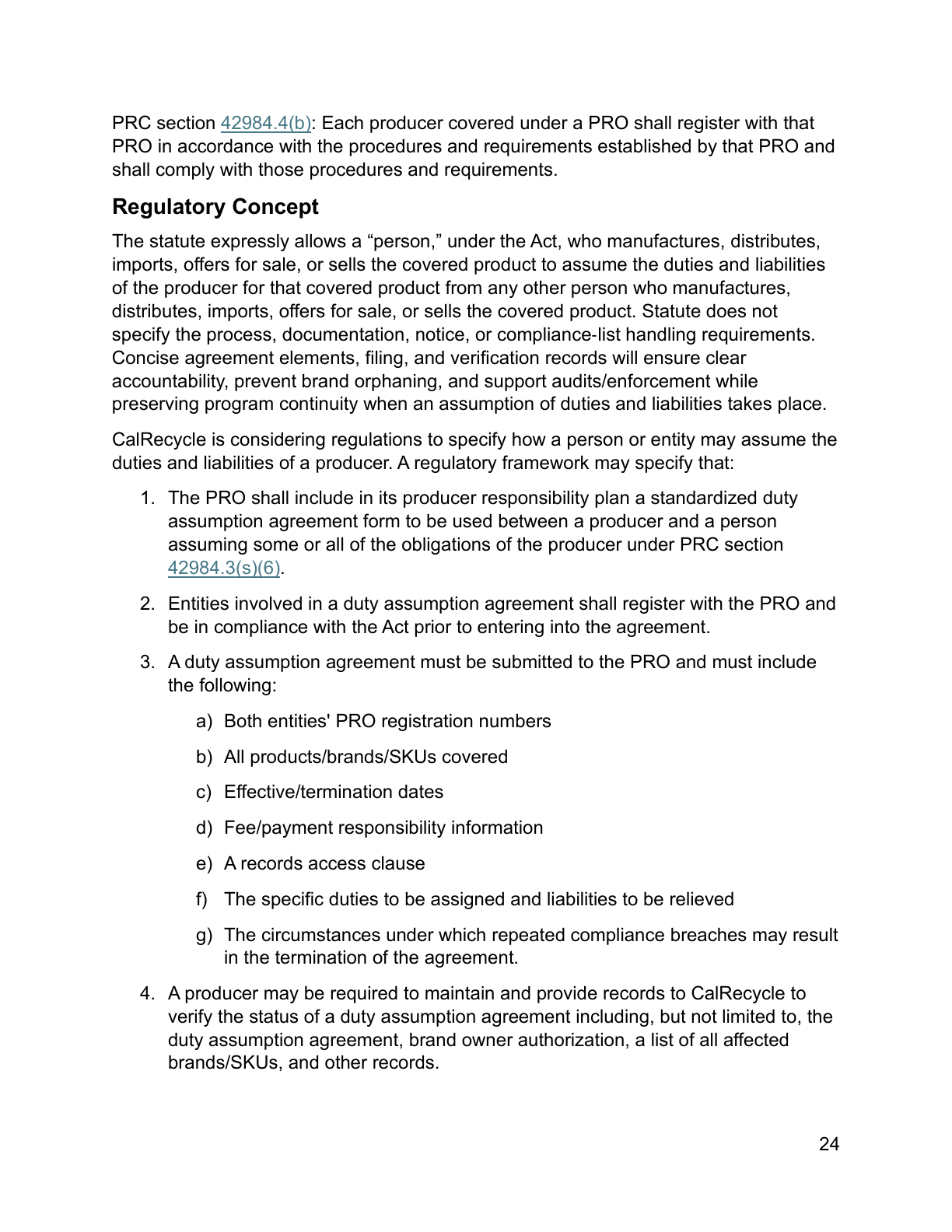
Entities involved in a duty assumption agreement shall register with the PRO and be in compliance with the Act prior to entering into the agreement.
The concept would place a standardized agreement form in the PRO plan. Its seven filing fields are both entities’ registration numbers, covered products and brands and SKUs, effective and termination dates, fee responsibility, a records-access clause, specified duties and liabilities, and circumstances in which repeated breaches may terminate the agreement. The broader framework has eight numbered provisions across pages 24 and 25. Supporting records could include the agreement, brand-owner authorization and the affected brands and SKUs.11
Source note 11
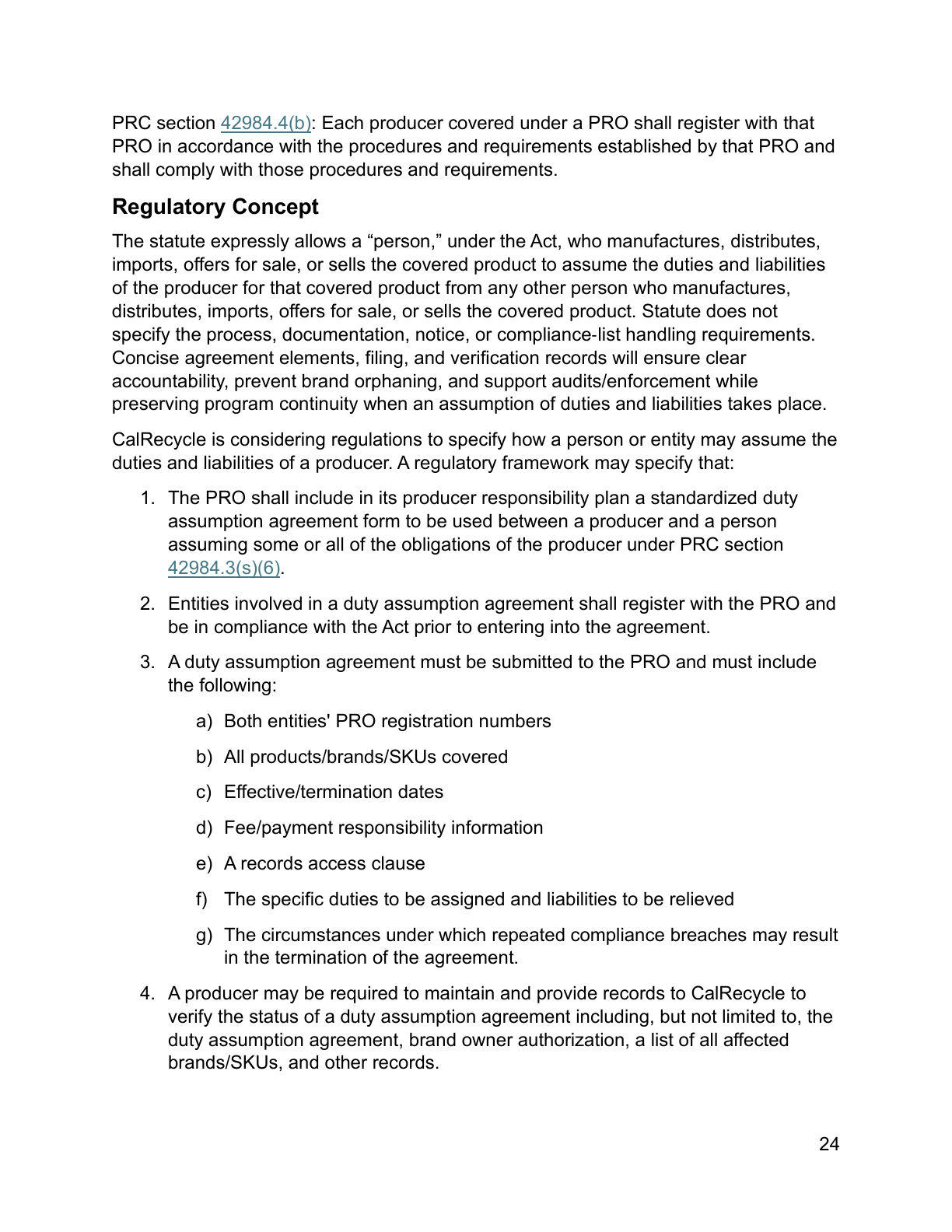
The concept’s possible nullity triggers include the assuming party ceasing to exist, dissolving, becoming insolvent or becoming unresponsive to the PRO or CalRecycle. It would recognize compliance for the covered producer and products only after PRO approval and confirmation that the assuming entity meets its own and assumed obligations. The assuming entity would have to be in the state with respect to the Act. These are proposed conditions. A private promise to pay fees is not described in the document as sufficient to complete the proposed process.12
Source note 12
We read the proposed agreement as the practical instrument for an eligible licensor and licensee to allocate duties. The text does not mention the license agreement, a sell-off period after termination or consolidated filings for several licensees. Our recommendation is to connect the assumption schedule to the underlying license and identify what survives expiration. We would distinguish the agreement’s end date from the last date on which covered goods are sold. We would also specify who can supply the records needed to prove the assuming party remains compliant.12
Source note 12
3.4 Exemptions and lists still need a relationship to the brand
The process shall require annual renewal by small sellers.
The September small-seller concept would use standardized forms, supporting records, notice to CalRecycle and annual renewal. The statute’s aggregation tests concern ownership, voting, board appointment and rights to manage affairs, with related-entity combinations. The August discussion document proposes turnover as gross revenue across covered and other sales, inside and outside California. Its feedback question expressly includes licensing relationships among the structures needing clarification. We read a royalty relationship alone as different from the enumerated control rights, while recognizing that the actual agreement and corporate structure must be examined.13
Source note 13
September’s additional-list concepts name a Small Seller List and a Personal Protective Equipment List. Proposed fields include entity name, product name and effective date, with evidence and update procedures. The August producer-and-brand-list concept names producer, associated brands, covered products, contact information and registration date. Neither field list expressly identifies the registrant’s relationship to the brand. Our reading is that a relationship field and an assumption-agreement reference would make the list interpretable when several licensees deal in different products under one mark.14
Source note 14
That distinction has a statutory consequence. PRC 42984.20(c)(2) ties the sales prohibition, after plan approval, to the producer’s compliance listing for that brand and covered product. Subdivision (d) contains exceptions for a seller fulfilling the obligations itself, a compliant listing at the relevant sale date and specified existing inventory. We read the brand, product and entity combination as the relevant record to reconcile. A brand appearing somewhere on a list does not by itself answer the question posed by the statutory wording.15
Source note 15
4. No commenter raised the licensing question in the recorded portions
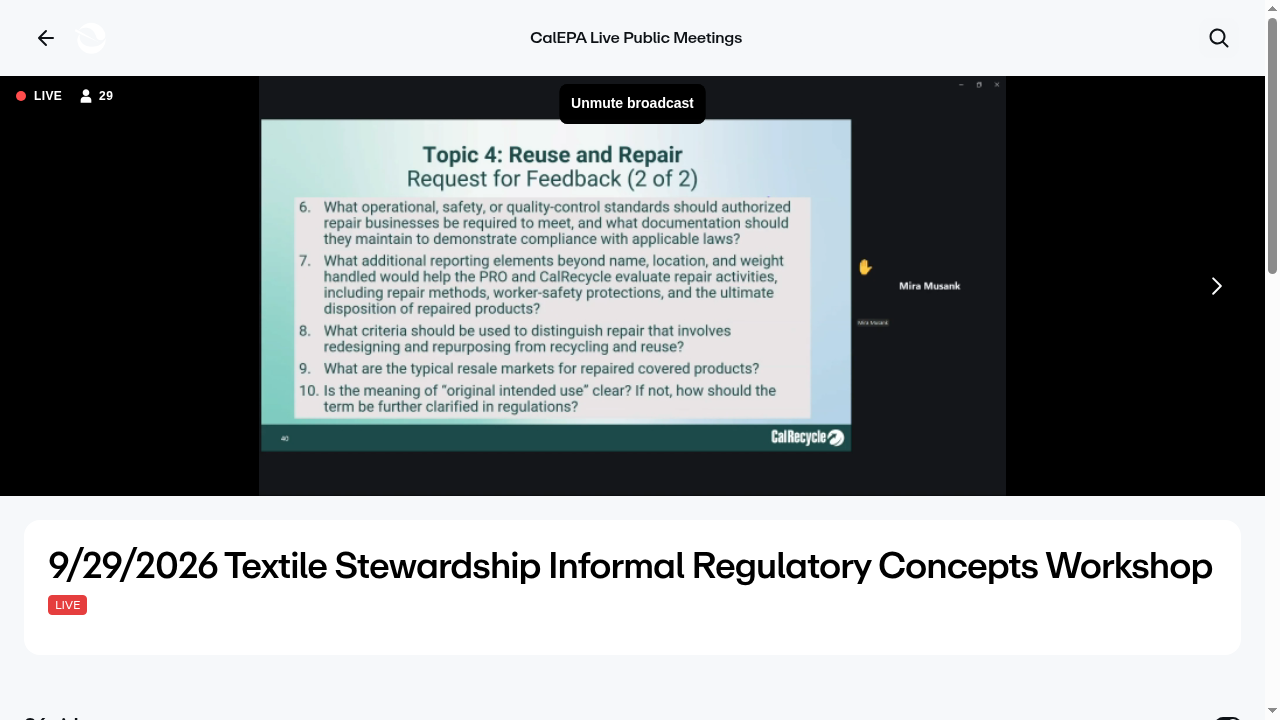
The moderator announced at 14:07:05 that Rob Hammerstad would present Part III straight through, with questions at the end. Hammerstad identified himself as supervisor of the Textiles Enforcement Unit at 14:07:36. He introduced Section 1’s four topics at 14:07:57, reached the hierarchy slide at 14:08:43 and moved to Section 2 at 14:08:52. The capture has no text between 14:09:12 and 14:20:20. Whether Section 1’s concepts were presented orally, and in what words, is not established by this record.16
Source note 16
What Rob's going to do is he's just going to go straight through this next section on producer identifications and exemptions. We're going to skip the individual comment period.
The captured invitation to questions began at 14:23:03. The moderator referred participants to the discussion document, asked about producer identification and exemptions, and moved on without a public comment on Part III. The close of that invitation is preserved below. Our inference is limited to that exchange and to the other recorded portions: the licensing question was not raised there. It is not a conclusion about every minute of the workshop, private discussions or written submissions.17
Source note 17
Well, if no one has anything to say about that, maybe you're all tired.
The recorded public discussion concentrated on the recovery system. Matthias Wallander of use again addressed international reuse at 10:15:47. Jessica Franken, speaking for SMART, discussed international secondhand markets at 10:49:52. Samantha Sabyrin of Just Zero introduced transparency and performance concerns at 10:54:23. Alexandra [Farah] of Fibershed discussed composting at 10:55:58. Ms. Wilson of New Echo Fab addressed dry weighing and chain of custody at 11:34:21. Tanita Gray of [Shoe’s LLC] discussed footwear recovery at 13:38:34. Janay D’Ambrosio of D’Ambrosio Trading addressed collection in small communities at 14:01:11.18
Source note 18
The October 6 and October 16 coverage review also provides a narrower starting point than a claim of novelty. Katten discusses exclusive and non-exclusive licensees and allocation by contract. Curtis describes contractual assumption of duties and recommends reviewing licensing agreements. We distinguish that allocation from the question of statutory producer identity. We build on those questions. Our inference is that the September documentation proposals make it possible to ask more precisely which agreement provisions and brand relationships belong in the administrative record. We do not infer from a search that no other adviser has considered them.19
5. We asked CalRecycle to make the licensing relationship explicit
We submitted our comment letter on October 6, 2026. Appendix A reproduces the sent text. Its six requests concern registration evidence, the territorial test, duty assumption, producer-and-brand lists, the small-seller exclusion and annual reporting. The letter’s proposals should be read as recommendations. Submission does not establish agency agreement with them.20
Source note 20
- Registration: we asked for a registrant’s relationship to each brand and evidence of California exclusivity and manufacturing rights.20
- Territory: we supported alignment with the SB 54 territorial test and asked which tiers the test would govern.20
- Duty assumption: we supported a standardized agreement with additions for the license’s term and sell-off period, consolidated schedules, notice and a cure period, and an express allocation of duties and liability.20
- Brand lists: we asked for fields identifying the relationship to the brand and any assumption agreement.20
- Small sellers: we asked for clarification that a license alone does not aggregate licensor and licensee turnover.20
- Annual reporting: we asked who reports when both parties are registered, so the same units are not counted twice or omitted.20
Source note 20
Our reading is that these requests connect the registration decision to the later records used for compliance and reporting.20
Source note 20
6. A licensor can reconcile its records before the next workshop
The statutory deadline to join the approved PRO was July 1, 2026. Landbell USA’s published registration guidance describes a flat $1,000 administrative fee for the 2026–2027 cycle. Neither that fee nor an account in a registration system settles the licensing analysis in this brief. Our recommendation is to confirm, brand by brand and category by category, which legal entity registered, the tier it relied on, and the agreement provisions supporting that position. Keep a record of the response rather than inferring coverage from the brand name alone.21
Source note 21
We recommend four preparatory steps. First, reconcile the registration record with the covered products and entities in the licensing portfolio. Second, read the agreement for manufacturing, import, exclusivity, territory and specification-approval rights. Third, identify any eligible assuming party and prepare a schedule of duties, brands, SKUs, dates, records access and fee responsibility. Fourth, trace the proposed reporting path from the licensee’s product and sales records to the information the PRO needs. These are our recommendations, derived from the statutory hierarchy and the written concepts, rather than additional regulatory requirements.22
Source note 22
For that fourth step, PRC 42984.17(g) requires the PRO’s annual report to state amounts sold in or into California, broken down by fiber-type category and Harmonized Tariff Schedule of the United States number. Subdivision (k) separately addresses collected products attributed to a registered producer. We would reconcile the identity used in registration with the entity supplying sales data before combining reports. We would ask how a transfer between licensor and licensee is distinguished from a sale into California, and how two registered parties prevent counting the same covered product twice.23
Source note 23
CalRecycle’s next noticed workshop is November 12, 2026, from 10:00 AM to 5:00 PM Pacific Time, at Byron Sher Auditorium, 1001 I Street, Sacramento, with Zoom participation and a public webcast. The announced topics are the Producer Responsibility Plan, Contingency Plan, Plan Termination, Plan Revocation and Cessation of PRO Status, and Annual Reports. We regard the annual-report discussion as the next place to test the reporting question. The notice establishes the agenda, not an outcome on allocation or double counting.24
Source note 24
The dates distinguish existing duties from later implementation
- Past
Workshop on end markets, reuse, repair, collection and producer identification. Transcript coverage is qualified in section 7.
Source 3
7. The written concepts and captured discussion serve different purposes
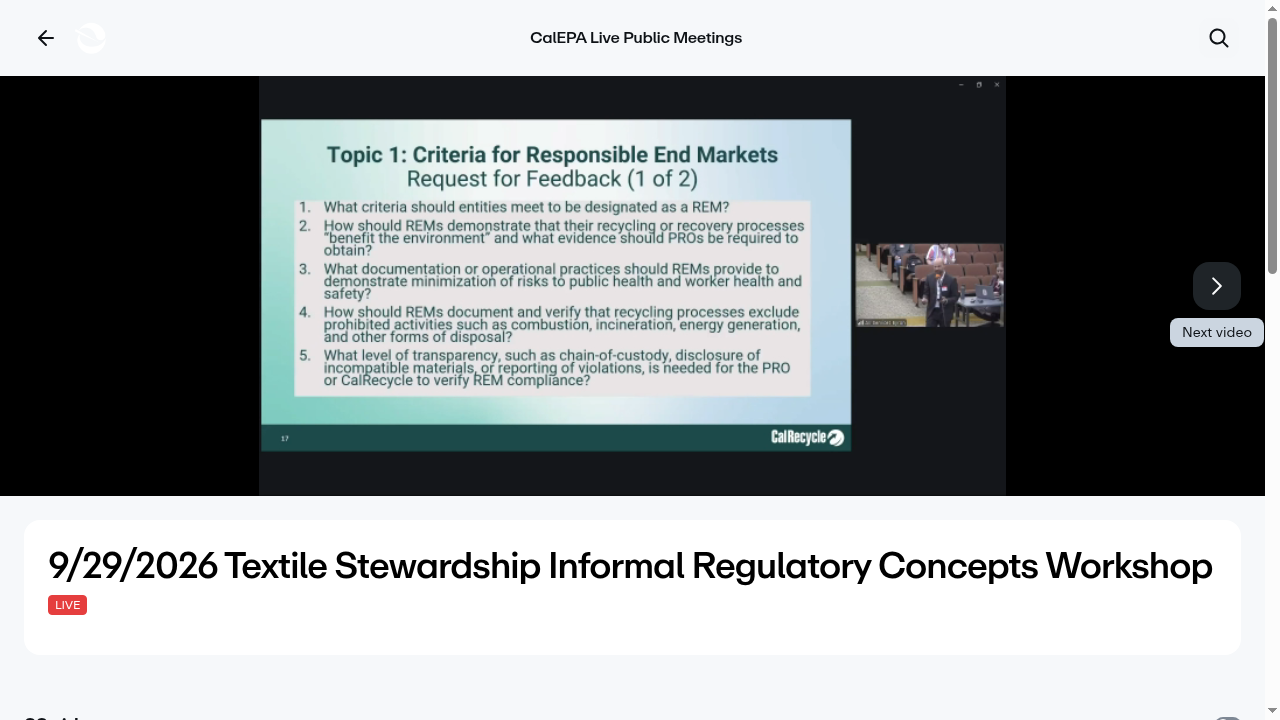
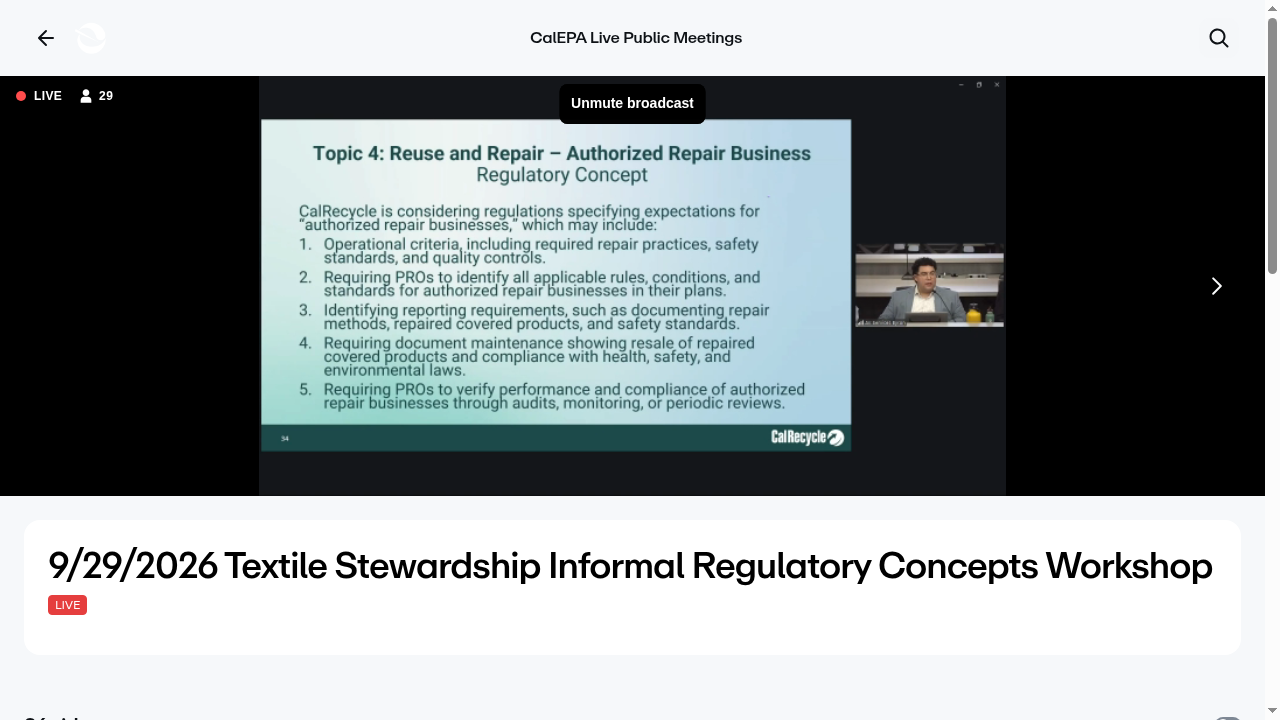
We watched the public webcast live and transcribed it automatically with Pacific Time timestamps. Marked transcript quotations are verbatim from that capture and may contain recognition errors. We correct a word only where the capture notes or discussion document make the intended reading unambiguous, and mark the correction in brackets. Appendix C retains the full captured passages for the quotations used here. The document excerpts are written agency text, presented separately from the spoken record.25
Source note 25
The coverage bar identifies the capture intervals and interruptions: about 10:00–10:05, about 10:18–10:48, 10:57:29–10:59:11, about 11:33–11:34, 14:09:12–14:20:20 and the closing interruption before 14:31:34, alongside the lunch break. The notes estimate the closing interruption at about 14:29:30, while the supplied transcript’s preceding text ends at 14:24:41. We use the wider interval for transcript coverage. Accordingly, every statement that no commenter raised the licensing question refers to recorded portions. We did not use an official recording to validate these quotations.26
Source note 26
Dark segments indicate captured portions, hatched segments indicate capture interruptions, and the outlined segment is lunch. Bounds marked “about” are estimates from the capture notes. Coverage within a segment does not establish word-for-word completeness.
- About 10:00–10:05: capture interruption
- About 10:05–10:16:24: captured
- 10:16:24–10:47:59: transcript interruption, estimated as about 10:18–10:48 in the notes
- 10:47:59–10:57:29: captured portions
- 10:57:29–10:59:11: capture interruption
- 10:59:11–about 11:33: captured
- About 11:33–11:34: capture interruption
- About 11:34–12:00: captured
- About 12:00–13:00: lunch break
- About 13:00–14:09:12: captured portions
- 14:09:12–14:20:20: capture interruption
- 14:20:20–14:24:41: captured
- 14:24:41–14:31:34: transcript interruption, including the about 14:29:30–14:31:34 gap in the notes
- 14:31:34–about 14:35: captured close
Statutory passages reproduced in the discussion document were checked against the Legislative Counsel’s current code on October 16, 2026. We use that code for provisions outside the discussion document and for the timeline dates. Concepts are described conditionally because a discussion document does not itself establish the final regulations. The source register distinguishes primary texts, our contemporaneous capture and secondary commentary. Interpretations of licensing structures and suggested next steps are identified as our reading or recommendations.27
Prior coverage was searched on October 6 and October 16, 2026. The review covered Katten, Curtis, Foley & Lardner, DLA Piper, Holland & Knight, Sidley, K&L Gates, Beveridge & Diamond and Greenberg Traurig, alongside AAFA, NRF, RILA, California Retailers Association, Licensing International, License Global, The Licensing Letter, Total Licensing and SMART. Search terms combined SB 707 and Responsible Textile Recovery Act with licensor, licensee, licensing and duty assumption. Search findings describe accessible published material, not the complete comment record. We submitted the letter in Appendix A and have a commercial interest in licensors understanding this regulation.28
Appendix A. Our comment letter, as submitted
Submitted October 6, 2026. The text below reproduces the sent email body. The signature’s phone number is omitted. The recommendations are those made in the letter, rather than statements of adopted rules.
Hello CalRecycle Team,
Vestra is a software company that works with brand licensors and their licensees on license agreements and royalty reporting. We are writing on Part III of the September 29 discussion document because licensed brands are a large share of the apparel, footwear, and accessories sold in California, and the current concepts do not yet say how a licensor and a licensee are told apart.
In the fashion and footwear business, a brand owner commonly licenses its brand to a separate company that designs, manufactures, imports, and sells the product under that brand. A single licensor may have dozens of licensees, each covering a different product category, and each with its own territory, which may or may not include California. The license agreement is the only document that records who manufactures, who imports, whether the license is exclusive, and whether the licensor approves product specifications. Each comment below comes back to that document.
1. Identification and Registration Process (Section 1, Topic 1, feedback question 2)
The statute places a manufacturing licensee at the top of the producer hierarchy under PRC 42984.3(s)(1), and places the brand owner or exclusive licensee at (s)(2) only when no (s)(1) producer is in the state. Whether a given company is a licensee, and whether that license is exclusive for California, can only be shown by the license agreement. The registration process could ask each registrant, for each brand, to state whether it owns the brand or holds a license to it, and if a license, whether the license is exclusive for California and whether it includes manufacturing. A copy of the governing provisions, or a signed attestation referencing the agreement, would be sufficient documentation. The French textile scheme (Refashion) already requests brand exploitation contracts for this purpose.
2. "In or into the State" (Section 1, Topic 2)
We support aligning the definition with the one already adopted for SB 54 at 14 CCR 18980.1.1(a), so that a person is in the state when subject to California courts under CCP 410.10 and either serviceable in the state or consenting and registered. Many of the same companies are producers under both programs, and one test will mean fewer disputes. We ask CalRecycle to confirm in the regulation that the test applies to (s)(1) and (s)(2) only, as it does under SB 54, and that an out-of-state licensee selling direct to California consumers is reached through (s)(5), which deems the sale to occur in the state.
3. Duty Assumption (Section 1, Topic 3, feedback questions 1 through 4)
We support the standardized agreement and the list of required elements, and have four additions.
a) Where the assuming party is a licensee and the relieved party is the brand owner, or the reverse, the agreement should identify the license agreement by date and parties, and state whether the assumed duties survive expiration or termination of the license. Licenses end on a schedule and products are sold off for months afterward. The regulation should say who is the producer for the sell-off period.
b) The agreement should allow a brand owner to assume duties for several licensees in one filing, and allow a licensee to assume duties for several brands in one filing, with one schedule listing the brands and covered product categories. Licensors with many licensees would otherwise file dozens of near-identical agreements.
c) On question 4, when an assuming party falls out of compliance, the PRO should notify the relieved party in writing before the brand is removed from the compliant producer list, with a cure period of at least 30 days. Under PRC 42984.20(c)(2), removal stops retail sale of the product. A brand owner that assigned its duty in good faith should learn of the problem from the PRO before learning it from a retailer.
d) The agreement should state which duties may be assumed. Registration, reporting, fee payment, and recordkeeping should be assignable, with liability for penalties following the assumed duty.
4. Producer and Brand Lists (Section 3, and the August 13 Part III Topic 3)
The list fields under evaluation are producer name, associated brands, covered products, contact information, and registration date. Under PRC 42984.3(e), a brand identifies "the owner or licensee of the brand," so the same brand may appear under several producers, one per product category. Two more fields would fix this: the registrant's relationship to the brand (owner, exclusive licensee, non-exclusive licensee, importer, or retailer), and a reference to any duty assumption agreement on file. Without these, the public list will show a brand next to one registrant with no way to tell whether that registrant is the owner or one of several licensees, and whether the owner has any remaining duty.
5. Small Seller Exemption (Section 1, Topic 4, and the August 13 turnover question)
The August 13 document asked which business structures, including licensing relationships, need clarification for aggregate global turnover. The regulation should say that a licensor's turnover and a licensee's turnover are not aggregated by reason of the license alone. A license is a commercial contract between separate companies, not common control. A small licensee of a large brand should qualify for the exemption on its own numbers, and a brand owner should not lose the exemption because of its licensees' sales.
6. A request for the November 12 workshop
Reporting under PRC 42984.17(g) will require sales into the state by fiber type and HTS number. For licensed brands, that data is produced by the licensee and is already reported to the licensor in a different form on the royalty report. We ask that the annual report and fee concepts at the next workshop address who reports for a licensed brand when both parties are registered, so that the same units are not counted twice or missed entirely.
We would welcome the chance to discuss any of these points with the Product Stewardship Branch. Nothing in this letter is confidential.
Sincerely, Philip Camuto Co-Founder, Vestra philip@vestra.so vestra.so
Appendix B. Source register
California Legislative Counsel. Definitions. PRC 42984.3.
https://leginfo.legislature.ca.gov/faces/codes_displaySection.xhtml?sectionNum=42984.3.&lawCode=PRCCalRecycle. Textile Stewardship Informal Regulatory Concepts Workshop: discussion document. September 29, 2026, 31 pages.
https://www2.calrecycle.ca.gov/PublicNotices/Details/7201/research/sb-707/SB707-discussion-document.pdfCalRecycle. September 29 workshop public notice. Notice 7201.
https://www2.calrecycle.ca.gov/PublicNotices/Details/7201CalRecycle. November 12 workshop public notice. Notice 7228.
https://www2.calrecycle.ca.gov/PublicNotices/Details/7228CalRecycle. August 13 discussion document. Document 18383, pp. 15–17 and 25.
https://www2.calrecycle.ca.gov/PublicNotices/Documents/18383Landbell USA. Registration support and fee guidance. 2026–2027 registration cycle.
https://landbellusa.com/registration-support/Katten Muchin Rosenman. California Responsible Textile Recovery Act. June 2026, sections 3–4 and 7.
https://katten.com/california-responsible-textile-recovery-actInternet ArchiveCurtis, Mallet-Prevost, Colt & Mosle. California Responsible Textile Recovery Act: What Fashion and Luxury Companies Need to Know. September 10, 2026.
https://www.curtis.com/our-firm/news/california-responsible-textile-recovery-act-what-fashion-and-luxury-companies-need-to-knowCircular Action Alliance. California covered materials and producer definitions. May 2026, 14 CCR 18980.1.1(a) reproduced.
https://circularactionalliance.org/s/CALIFORNIA-CoveredMaterialsProducerDefinitions-May-2026-v12.pdfCircular Action Alliance. Oregon covered materials and producer definitions. 2026 updates, Appendix A.
https://circularactionalliance.org/s/OREGON-2026-Updates_-Covered-Materials-Producer-Definitions.pdfCircular Action Alliance. Colorado producer guidance. 2026, Regulation 18.2.2 reproduced.
https://circularactionalliance.org/s/Colorado-Producer-Guidance-2026-r7m9.pdfVestra, capture of CalEPA public webcast. Automatic workshop transcript and contemporaneous notes. September 29, 2026, Pacific Time.
https://video.calepa.ca.gov/?event=5965127&video=1196763203/research/sb-707/transcript.htmlVestra. Research record and coverage review. Memos 01–06, October 6, and search review, October 16, 2026.
Research record and coverage reviewPhilip Camuto, Vestra. Comments on the September workshop. Submitted October 6, 2026.
Comments on the September workshopCalifornia Legislative Counsel. Responsible Textile Recovery Act of 2024. SB 707, Stats. 2024, ch. 864.
https://leginfo.legislature.ca.gov/faces/billNavClient.xhtml?bill_id=202320240SB707California Legislative Counsel. Regulations and effective date. PRC 42984.2.
https://leginfo.legislature.ca.gov/faces/codes_displaySection.xhtml?sectionNum=42984.2.&lawCode=PRCCalifornia Legislative Counsel. Producer requirements. PRC 42984.4.
https://leginfo.legislature.ca.gov/faces/codes_displaySection.xhtml?sectionNum=42984.4.&lawCode=PRCCalifornia Legislative Counsel. Amendments to Public Resources Code. AB 1170, Stats. 2025, ch. 67.
https://leginfo.legislature.ca.gov/faces/billNavClient.xhtml?bill_id=202520260AB1170California Legislative Counsel. Needs assessment. PRC 42984.6.
https://leginfo.legislature.ca.gov/faces/codes_displaySection.xhtml?sectionNum=42984.6.&lawCode=PRCCalRecycle. Textile PRO application and approval. Landbell USA approved February 27, 2026.
https://calrecycle.ca.gov/epr/textiles/textileproapp/California Legislative Counsel. Producer responsibility plan. PRC 42984.8.
https://leginfo.legislature.ca.gov/faces/codes_displaySection.xhtml?sectionNum=42984.8.&lawCode=PRCCalifornia Legislative Counsel. Brand list. PRC 42984.5.
https://leginfo.legislature.ca.gov/faces/codes_displaySection.xhtml?sectionNum=42984.5.&lawCode=PRCCalifornia Legislative Counsel. PRO annual report. PRC 42984.17.
https://leginfo.legislature.ca.gov/faces/codes_displaySection.xhtml?sectionNum=42984.17.&lawCode=PRCCalifornia Legislative Counsel. Compliance lists and sales restriction. PRC 42984.20.
https://leginfo.legislature.ca.gov/faces/codes_displaySection.xhtml?sectionNum=42984.20.&lawCode=PRCCalifornia Legislative Counsel. Administrative civil penalties. PRC 42984.21.
https://leginfo.legislature.ca.gov/faces/codes_displaySection.xhtml?sectionNum=42984.21.&lawCode=PRCCalRecycle. September 29 workshop presentation. Document 18507, 91 slides.
https://www2.calrecycle.ca.gov/PublicNotices/Documents/18507CalRecycle. Textile stewardship event and program record. Recording-link check, October 16, 2026.
https://calrecycle.ca.gov/epr/textiles/Internet Archive
Appendix C. The quoted moments in context
[14:07:00] in the room? All right, so we're going to do something a little different for [14:07:05] our next section. And we do have robust discussion questions in the discussion [14:07:11] document. What Rob's going to do is he's just going to go straight through this next [14:07:16] section on producer identifications and exemptions. We're going to skip the [14:07:20] individual comment period. And then we're going to accept questions on this entire [14:07:24] part at the end to help save us a little time. So go Rob. Hi everybody. Can you [14:07:36] hear me? All right. I'm Rob Hammerstad. I'm the supervisor for the Textiles [14:07:41] Enforcement Unit. I'll be guiding us through part three of today's workshop. Part [14:07:47] three will be an overview of proposed regulatory concepts related to producer [14:07:50] identification, product exclusion, and lists. Next slide, please. As you can see [14:07:57] on the slide displayed section one producer identification includes four [14:08:01] topics. Identification and registration process in or into the state duty [14:08:07] assumption and small seller exemption process. Next slide, please. Section two product [14:08:15] exclusion includes the following topics, second hand covered product, personal [14:08:19] protective equipment exclusion process, section three additional lists [14:08:24] includes the following topics list types and process to add a list entry. For [14:08:29] each topic, we will present the concept or concepts before opening the floor to [14:08:33] questions feedback and comments at the end of this section. So excuse me, not [14:08:37] after each topic after the section. Next slide, please. [14:08:43] Statutory background related to producer identification is on the slide and [14:08:47] the following two slides. This slide illustrates the approach taken by the act [14:08:52] in determining who is a producer and thus there is slide 70. Thank you. Okay, [14:08:56] we'll now move to section two focus on exclusion of covered products. Topics [14:09:01] include second hand covered product and personal protective equipment exclusion [14:09:05] process. Next slide, please. Statutory background related to the exclusion of a [14:09:12] second hand covered product is provided on this slide.
[14:22:43] Okay. [14:22:46] Did you want to take it for a question and comment that? [14:22:53] All right, yeah. [14:22:55] We saved a bunch of time doing it that way. [14:22:57] That was fun. [14:22:58] Now we have a 35 minutes for questions [14:23:01] and comments on this section. [14:23:03] Don't we have a request for feedback slide [14:23:05] or is this like a specific one with questions? [14:23:10] Yeah, yeah. [14:23:11] Let's pause it here for a second [14:23:13] and see if folks have questions [14:23:16] or feedback on these specific questions [14:23:20] and refer to the discussion document [14:23:22] on the ones that we presented [14:23:24] while Rob was covering the other topics. [14:23:29] What do you have to say about producer identification [14:23:32] and exemptions online? [14:23:39] I'm glad we didn't stop throughout [14:23:41] for questions and comments on the sections. [14:23:46] Okay. [14:23:47] Well, if no one has anything to say about that, [14:23:49] maybe you're all tired. [14:23:50] Let's go to the next slide [14:23:52] and here's another catch all on anything [14:23:56] that we talked about today. [14:23:57] Anything we missed, anything, [14:23:59] any questions that you have? [14:24:01] You want to preview on what we're talking about [14:24:04] at upcoming workshops? [14:24:06] What else do you have to share with us today? [14:24:10] Or something you didn't get to say when you're dying. [14:24:12] Go ahead, thank you.
Appendix D. Figure and slide index
Notes
- Our reading of the statutory hierarchy and written concepts. The silence finding is confined to the recorded portions.
- Market importance is our assessment, not a quantified share. The letter and statutory definitions provide the stated basis.
- PRC 42984.3 and 42984.21 were amended by AB 1170, Stats. 2025, ch. 67, effective January 1, 2026. The producer definition is unchanged. The October 6 research memos precede the live-code check.
- The fallback tiers and the consumer-delivery rule.
- Assumption is limited by the activities listed in the statute. The exclusion concerns global turnover and the specified related entities.
- All structure applications and proposed record formats are our inference. The table states the assumptions for each result.
- Packaging comparisons only. Oregon: OAR 340-090-0860(1)(a) and CAA Appendix A. Colorado: Regulation 18.2.2 and CAA producer guidance. Neither supplies a California textile rule.
- Written Part III concepts and the captured introduction. The transcript resumes at 14:20:20.
- The five proposed registration functions and feedback question 2. Our suggested agreement evidence is an inference.
- September’s proposal uses jurisdiction and/or voluntary assumption. The more specific packaging comparison is 14 CCR 18980.1.1(a).
- Seven filing fields appear as 3(a)–(g) on page 24. Eight numbered framework provisions span pages 24–25.
- Framework provisions 4–8 and feedback questions 1–4. The proposed licensing additions are our inference.
- September small-seller process. August Part I, Topic 3 supplies the turnover proposal and licensing-relationships question. The agreement-specific control analysis is our inference.
- September additional lists and August Part III, Topic 3, p. 25. The relationship-field recommendation is our inference.
- The sale restriction is conditional on plan approval and has statutory exceptions. Our record-reconciliation proposal is an inference.
- Part III introduction and the end of the first captured segment. The transcript has no intervening text before 14:20:20.
- The captured Part III invitation and its close. Appendix C reproduces the full exchange.
- Names and affiliations are spoken in the capture. [Farah] and [Shoe’s LLC] use the capture notes to bracket recognition corrections. Other spellings follow the transcript.
- Katten, sections 3–4 and 7. Curtis, “Covered Products and Responsible Producers” and “Key business takeaways.” The claimed contribution is our inference, not an exhaustive novelty claim.
- Vestra letter, submitted October 6, 2026. The sent record, rather than the earlier draft, supplies Appendix A.
- Statutory membership deadline and Landbell USA’s published administrative-fee guidance. The reconciliation steps are our recommendation.
- Preparatory recommendations, not adopted requirements.
- PRO annual-report requirements. The proposed reconciliation and double-counting questions are our inference.
- Notice 7228, retrieved October 16, 2026. The relevance to licensing is our inference.
- Contemporaneous capture and notes, September 29, 2026. Transcript provenance and editorial method.
- Capture notes plus direct timestamp inspection. The bar uses the transcript’s wider morning and closing intervals where they differ from the estimates.
- Source hierarchy: current code, written concepts, then capture. Dates checked live in PRC 42984.2, .4, .6 and .8 on October 16, 2026.
- Research memos 01–06 and the October 16 search log. The disclosure describes our own participation and interest.
Updates and corrections
2026-10-16. First edition. Statutory dates checked against the current code. The workshop quotations are drawn from the contemporaneous automatic capture.
Cite this brief
Camuto, Philip. “Who is the producer of a licensed brand under SB 707.” Vestra, October 16, 2026. Regulatory status as of October 16, 2026. https://vestra.so/research/sb-707
We welcome a comparison of notes with licensors working through the same question.
Write to Philip at philip@vestra.so.